
You open your banking app, scroll to last month’s grocery total, and do a double-take. Again. According to the USDA’s latest food cost reports, a family of four on a moderate budget is now spending somewhere between $1,100 and $1,390 per month just on groceries — and that’s cooking every single meal at home. Factor in the Bureau of Labor Statistics data showing food-at-home prices climbed another 2.7% between September 2024 and September 2025, and suddenly that bloated grocery bill makes a painful kind of sense.
But here’s what I’ve learned after years of covering personal finance and feeding two school-age kids on a reporter’s salary: the families who consistently spend $300–$400 less per month than their peers aren’t coupon-clipping obsessives or dietary ascetics. They’ve simply built a small set of systems — and they’re religious about them.
This isn’t a list of generic tips. What follows is a ranked, evidence-backed playbook. Think of these as compounding investments: each tip saves you money on its own, but layered together, they can realistically cut your monthly grocery bill by $250–$400. Let’s start with the one that makes all the others possible.
1. Meal Plan Before You Shop — Without Exception
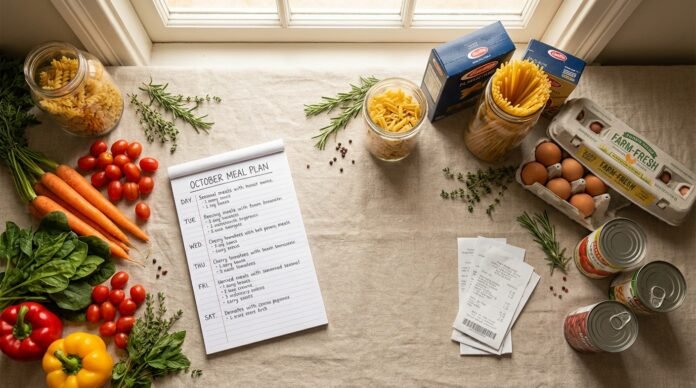
The Core Idea: Decide what you’re eating for the week before you set foot in a store. Every dinner, every school lunch, a rough idea of breakfasts. Then — and only then — build your shopping list.
Why It Works: Supermarkets are engineered environments. The lighting, the placement of staples at the back, the enticing end-cap displays — all of it is designed to extract unplanned purchases. Behavioral economists call this “choice overload,” and research consistently shows that shoppers without a defined list spend significantly more. One study published in the Journal of Nutrition Education and Behavior found that meal planning is associated with both reduced food expenditure and less food waste.
Actionable Steps:
- Every Sunday (or whatever day precedes your main shopping trip), spend 20 minutes deciding on five or six dinners.
- Write them down. Check your pantry and fridge before adding ingredients to your list — you likely already have garlic, olive oil, canned tomatoes.
- Plan for deliberate leftovers. If you’re roasting a chicken on Monday, Tuesday becomes chicken tacos. Wednesday, the carcass makes stock.
- Build school lunches into the same plan. This alone can save $40–$60 a month compared to buying individually packaged snack items without a strategy.
Real-World Example: When I stopped “winging it” mid-week and started building a proper list, I noticed something almost immediately: my cart stopped filling itself with duplicates of things I already owned and impulse items I never used. The chaos tax is real.
Estimated Savings: $80–$120 per month (reduced impulse purchases + less food waste).
2. Treat Food Waste as a Line Item You’re Hemorrhaging
The Core Idea: The average American household throws away roughly 30–40% of the food it purchases, according to USDA estimates. For a family of four spending $1,200/month on groceries, that’s potentially $360–$480 going directly into the trash.
Why It Works: We don’t feel like we’re throwing away money, because waste happens incrementally — a forgotten bag of salad here, a container of leftover pasta that never got eaten there. Making waste visible changes the math.
Actionable Steps:
- Designate one shelf in your fridge as the “eat first” shelf. Everything that needs to be used within the next two days lives there, front and center.
- Do a weekly fridge audit every Friday before grocery shopping. Use what you see before you buy more.
- Learn to freeze strategically. Bananas going brown? Freeze them for smoothies or banana bread. Bread about to go stale? Freeze it. Cooked grains, soups, and beans all freeze beautifully.
- Buy whole vegetables over pre-cut. Pre-cut broccoli florets cost significantly more per pound and go bad faster.
Real-World Example: A friend of mine — a mother of twins — started photographing her fridge before every shopping trip. Simple habit. Within three months, she’d slashed her weekly spend by nearly $35 just by buying less of what she already had.
Estimated Savings: $60–$120 per month.
3. Audit Your Store Choice — Loyalty Costs More Than You Think
The Core Idea: Where you shop matters enormously. Studies comparing conventional supermarkets to discount chains like ALDI and Lidl have found price differences of 20–30% on comparable items. If you’ve been shopping at a full-service grocery chain out of habit, you’re likely leaving hundreds of dollars a year on the table.
Why It Works: Premium supermarkets spend heavily on ambiance, variety, and customer experience — costs that get baked into their prices. Discount grocers strip out these extras and pass the savings along. This isn’t about sacrificing quality; Consumer Reports and numerous independent food writers have found that ALDI’s private-label products routinely match or beat name-brand equivalents in taste tests.
Actionable Steps:
- Identify the discount grocer closest to you (ALDI, Lidl, WinCo, Grocery Outlet, Market Basket, depending on your region).
- For one month, buy your staples — produce, dairy, eggs, pantry basics — there. Continue using your regular store for specific items you can’t find elsewhere.
- Price-check 10 items you buy regularly. Most families find they can do 70–80% of their shopping at discount stores without any noticeable change in quality.
- Warehouse clubs like Costco make sense for large families — but only for things you actually consume in bulk before they expire. Focus on non-perishables, frozen proteins, and household staples.
Real-World Example: Switching even half of your weekly shopping to a discount grocer — realistic for most families — can result in meaningful monthly savings without changing what you eat.
Estimated Savings: $70–$130 per month.
4. Master the Protein Swap
The Core Idea: Protein is the most expensive line item in most grocery carts. Strategic substitutions — not deprivation — can dramatically reduce costs without sacrificing nutrition or satisfaction.
Why It Works: Many families default to boneless, skinless chicken breasts or specific cuts of beef out of habit, even when cheaper, equally nutritious options exist. Registered dietitians are consistent on this: canned beans, lentils, eggs, canned fish, and bone-in chicken thighs deliver comparable (and in many cases superior) nutrition at a fraction of the cost.
Actionable Steps:
- Replace two weekly dinners with legume-based proteins: lentil soup, black bean tacos, chickpea curry. Budget-wise, a pound of dried lentils ($1.50–$2) can feed a family of four multiple times.
- Swap chicken breasts for bone-in thighs. They typically cost 30–50% less, stay moist when cooked, and most kids actually prefer the flavor.
- Keep canned fish (tuna, sardines, salmon) stocked. A tuna pasta bake or salmon patties costs a fraction of a comparable beef dish.
- Eggs remain one of the best value proteins available. Build one egg-centric dinner per week into your rotation.
Real-World Example: Two meatless dinners a week — not a deprivation experiment, but two genuinely good lentil and bean-based meals — can save a family of four $30–$50 per month without anyone feeling shortchanged.
Estimated Savings: $40–$80 per month.
5. Buy Strategically in Bulk — But Only What Qualifies
The Core Idea: Buying in bulk saves money only on items you will actually use before they expire. Buying a 10-pound bag of rice: smart. Buying a 5-pound tub of mayo that sits in your fridge for two years: counterproductive.
Why It Works: Economies of scale are real — the unit price on bulk staples is genuinely lower. The trap is over-purchasing perishables or novelties because the per-unit price feels too good to refuse. The Food Marketing Institute has documented that this “deal psychology” is one of the primary drivers of household food waste.
Actionable Steps:
- Make a permanent bulk list: items you use constantly, that don’t expire quickly, and that store well. Rice, pasta, dried beans, oats, flour, sugar, olive oil, canned tomatoes, frozen vegetables, frozen proteins.
- Evaluate warehouse club membership annually. Families of four who cook regularly typically break even or come out ahead on membership fees within a few months.
- Freeze bulk meat purchases the day you get home. Divide into meal-sized portions before freezing so you’re not defrosting more than you need.
- Never bulk-buy produce unless you have a specific plan to use or preserve it within days.
Estimated Savings: $30–$60 per month (net of any membership costs).
6. Weaponize Store Sales Cycles — Without Clipping a Single Coupon
The Core Idea: Every grocery store runs on predictable promotional cycles. Understanding these patterns lets you stock up at the lowest price points without obsessively clipping paper coupons.
Why It Works: Most stores rotate major protein and pantry sales on roughly a 6–8 week cycle. When chicken thighs are on sale, that’s the week to buy and freeze three or four weeks’ worth. When pasta drops to $0.79/box, buy ten. This approach — sometimes called the “stockpile method” by frugal living writers at outlets like The Kitchn — essentially lets you pay sale prices nearly year-round.
Actionable Steps:
- Download your store’s app or weekly flyer and spend five minutes reviewing it before each shopping trip.
- Build a simple “price book” — even a note in your phone — of what you typically pay for your 15 most commonly purchased items. When something drops significantly below that baseline, stock up.
- Look for markdowns on proteins at the meat counter, particularly in the morning. Many stores discount meat that’s approaching its sell-by date. Buy it and freeze it immediately.
- Wednesday is often when new weekly deals begin at many chains — useful timing if you can shop mid-week.
Estimated Savings: $30–$60 per month.
7. Cook in Batches, Eat in Themes
The Core Idea: Cooking large batches of foundational ingredients — a big pot of grains, a tray of roasted vegetables, seasoned ground beef — gives you flexible building blocks for multiple meals without cooking from scratch every night.
Why It Works: Weeknight exhaustion is the enemy of budget cooking. When dinner at 6pm feels impossible to produce, the temptation to order in or grab a rotisserie chicken with four side dishes at $40 becomes overwhelming. Batch cooking eliminates this decision fatigue. According to meal planning experts and financial coaches interviewed by outlets like NerdWallet, families that batch cook one day a week significantly reduce both their food spend and their takeout frequency.
Actionable Steps:
- Pick one block of time per week — Sunday afternoon, Saturday morning — and cook in volume. Make a large batch of grains (quinoa, rice, farro), roast a sheet pan of vegetables, and cook a double portion of whatever protein you’re making anyway.
- Theme your weeks loosely: “Mexican week” uses the same seasoned beans in tacos, burrito bowls, and quesadillas. “Mediterranean week” cycles through the same roasted vegetables, chickpeas, and pita in different combinations. Kids adapt to themes surprisingly well, and you waste almost nothing.
- Keep a simple “what can I make tonight?” list on your phone based on what’s prepped in the fridge. This is the system that prevents the $40 takeout order.
Estimated Savings: $50–$80 per month (primarily in reduced takeout and delivery).
The Compound Effect: What This All Adds Up To
Let’s be conservative. If you implement all seven strategies and capture only the low end of each estimated savings range, you’re looking at: $80 + $60 + $70 + $40 + $30 + $30 + $50 = $360 per month.
That’s over $4,300 a year — without eating less well, without deprivation, and without spending your Sundays clipping coupons.
Where to start if this feels overwhelming: Don’t try to implement all seven at once. Begin with Tip #1 (meal planning) because every other tip is easier with a plan in place. Add Tip #2 (reduce food waste) in week two — it requires zero extra spending and often shows the fastest results. Once those two feel natural, audit your store choices. The rest will follow.
The bigger picture here is this: grocery savings aren’t about grinding out discounts on individual items. They’re about building systems that make the right choices automatic. Plan ahead. Waste nothing. Shop smart. Those three principles, practiced consistently, will do more for your family’s food budget than any single sale or coupon ever could.
Sources consulted: USDA Food Plans Monthly Cost of Food Reports (January–December 2025); Bureau of Labor Statistics Consumer Price Index for Food at Home; USDA Thrifty Food Plan 2021; Journal of Nutrition Education and Behavior (meal planning research); Food Marketing Institute consumer spending reports; NerdWallet and The Kitchn expert commentary on budget meal strategies.