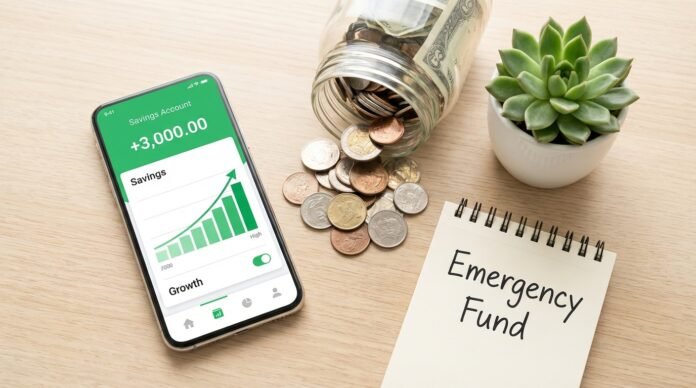
Here is what the average family with a traditional savings account is doing with their emergency fund right now: earning 0.39% APY — the FDIC’s recorded national average as of February 2026. On a $15,000 emergency fund (the rough target for a family of four with three to six months of essential expenses), that translates to about $59 in interest over an entire year.
Now here’s what that same $15,000 earns in one of today’s best high-yield savings accounts: between $600 and $750 annually, depending on the account. The difference — $540 to $690 per year — requires no additional risk, no investment skill, and no lifestyle change. It requires exactly one decision: opening a different account.
The best HYSAs continue to pay between 4.00% and 5.00% APY, several times what you’d earn at a traditional bank. The Federal Reserve made several rate cuts in late 2025 — good news for borrowers, less so for savers — but numerous high-yield savings accounts still deliver near or even over 4.00% APY as of March 2026. The window is open. It won’t stay this wide indefinitely.
This guide is specifically designed for families building or holding an emergency fund. The considerations that matter for families — access speed, account simplicity, partner access, and stability — are not always the same as the considerations that dominate generic HYSA comparisons. Here’s what you need to know.
Why the Emergency Fund Is the Starting Point for Every Other Financial Goal
Before comparing accounts, it’s worth being direct about why this matters so much for families specifically.
An emergency fund isn’t a savings goal in the traditional sense — it’s financial infrastructure. Without it, every other financial plan is structurally vulnerable. The car repair, the medical bill, the month of reduced income — any of these can become a credit card spiral without a cash buffer in place. At 21% APR on a carried credit card balance, the cost of not having an emergency fund compounds far faster than any HYSA earns.
Financial planners consistently recommend 3–6 months of essential expenses for families with children. For a family spending $5,000/month on non-negotiable costs (housing, utilities, food, insurance, childcare, debt minimums), that’s a target of $15,000–$30,000. That’s a meaningful sum — and one that deserves to earn real interest while it sits waiting.
At 4.50% APY with daily compounding, $10,000 earns approximately $459 in one year. At a traditional bank paying 0.45% APY, the same deposit earns only $45 — a difference of $414 per year. Scale that to a $20,000 family emergency fund and the gap is over $800 annually. For doing nothing differently except where you keep the money.
What Families Should Look for in an HYSA (Beyond the Rate)
The APY gets the headlines. But for families, four other factors matter just as much:
1. Accessibility and transfer speed An emergency fund is useless if you can’t access it quickly. The best HYSAs link seamlessly to your primary checking account and transfer funds within 1–3 business days. Some offer same-day or next-day transfers for established accounts. Verify this before opening — transfer speed varies meaningfully between institutions.
2. No monthly fees and no minimum balance requirements A savings account that charges a monthly maintenance fee is eroding the interest you’re earning. The best HYSAs have no minimum to open, no monthly fee, and strong APYs. This is now the standard for competitive online savings accounts — don’t accept anything less.
3. FDIC insurance Money in a high-yield savings account is federally insured up to $250,000 per depositor at FDIC-member institutions. For most families, a $15,000–$30,000 emergency fund sits well within this limit. Verify FDIC membership at fdic.gov before opening any account — this is especially important with newer online banks.
4. Mobile app quality and joint account access Two-income families often need both partners to have visibility into and access to the emergency fund. Look for accounts that support joint ownership and offer a well-reviewed mobile app. An emergency fund both partners can access isn’t just convenient — it’s a household finance best practice.
The Top HYSAs for Family Emergency Funds: March 2026
All rates as of late February/early March 2026. HYSA rates are variable and subject to change with Federal Reserve decisions.
🏆 Best Overall: Newtek Bank Personal High-Yield Savings
APY: 4.20% Minimum to open: $0 Monthly fees: None FDIC insured: Yes
Newtek Bank’s Personal High Yield Savings was selected as the best savings account in NerdWallet’s 2026 Best-Of Awards. The account has no minimum to open, no monthly fee, and earns a 4.20% APY — one of the highest rates available.
For families, the zero-minimum and zero-fee combination is the decisive factor. You can open this account with whatever you have available today and begin earning a competitive rate immediately. There’s no balance threshold to reach before the rate kicks in — every dollar earns from day one.
Best for: Families starting or rebuilding their emergency fund who want zero friction and a top-tier rate without balance requirements.
🥈 Best for Simplicity: Marcus by Goldman Sachs
APY: ~4.50% Minimum to open: $0 Monthly fees: None FDIC insured: Yes
Marcus has been a consistent HYSA leader for years, and its staying power reflects something specific: it’s genuinely simple to use. No minimum balance, no fees, a clean mobile interface, and a rate that consistently sits near the top of the market. For most savers, Marcus hits the sweet spot: strong APY, zero minimums, zero fees, and a top-rated app.
The Marcus mobile app is particularly well-reviewed among families who need both partners to have clean, intuitive access to the account. Joint account options are available.
Best for: Families who want a no-fuss, set-it-and-forget-it emergency fund account with a trusted, established institution.
🥉 Best Rate (with conditions): Varo Money
APY: Up to 5.00% (conditions apply) Minimum to open: $0 Monthly fees: None FDIC insured: Yes
Varo Money offers the top APY on most current comparison lists — up to 5.00% — with Axos Bank and Newtek Bank in second and third. The 5.00% rate is Varo’s headline number, but it comes with conditions: you must receive qualifying direct deposits totaling $1,000+ per month and maintain a positive balance. The rate applies to balances up to $5,000; balances above that earn a lower rate.
For families who can meet these conditions — and many two-income households can — Varo offers the highest available rate on the market. For those who can’t meet the thresholds consistently, the effective rate drops significantly.
Best for: Families with regular qualifying direct deposits who want to maximize interest on the first $5,000 of their emergency fund.
Best for Banking Integration: Axos ONE Bundle
APY: Up to 4.21% (savings component) Minimum to open: $0 Monthly fees: None FDIC insured: Yes
Axos ONE checking and savings bundle earns up to 4.21% APY on savings when you meet account requirements. For families who want their checking and high-yield savings in one place — with a single login, a single app, and simplified money movement — the Axos bundle is a strong option. Transfers between the checking and savings components are effectively instant, which matters when an emergency actually arrives.
Best for: Families who want the simplicity of keeping spending and emergency savings at the same institution without sacrificing rate.
Best for Maximum Security: Openbank (Santander)
APY: 4.09% Minimum to open: $500 Monthly fees: None FDIC insured: Yes (as part of Santander Bank, N.A.)
Openbank is a digital subsidiary of Santander Bank — a major established institution — offering an FDIC-insured savings account with a strong APY, no monthly fees, and the stability of a large bank behind it. The $500 minimum opening deposit is higher than most online-only competitors, but reasonable for families building an emergency fund.
For families who feel uneasy keeping significant savings at a newer, less-established online bank, Openbank offers near-top-tier rates backed by Santander’s long institutional history.
Best for: Families who prioritize institutional stability and want the backing of an established bank with competitive online rates.
Honorable Mention: SoFi High-Yield Savings
APY: Up to 4.00% (with direct deposit) Minimum to open: $0 Monthly fees: None FDIC insured: Yes
SoFi’s online bank account combines checking and high-yield savings with no monthly maintenance fees, no minimum balance requirements, and no minimum deposit requirement to open. The top rate requires a qualifying direct deposit, but SoFi’s strong mobile app, combined financial tools (budgeting, credit score monitoring), and family-friendly features make it worth consideration for parents who want their emergency fund embedded in a broader financial management platform.
The Rate Outlook: What Families Should Expect in 2026
This matters for your account choice. The Federal Reserve paused rate adjustments in January 2026 as expected, presenting an encouraging picture of a stabilizing environment. Another rate cut is unlikely before the second quarter of 2026, meaning savers are in a relatively strong position for the near term.
Most experts predict a couple more rate cuts before the end of 2026 — opening an account now helps families capture today’s best APYs while they’re still available.
The practical implication: lock in a strong-rate account now, but don’t treat today’s rate as permanent. When the Fed cuts rates, online banks typically follow within weeks — though they tend to lower rates more slowly than they raise them. Families should plan to monitor their HYSA rate annually and be willing to move their emergency fund to a higher-rate institution if the gap becomes meaningful.
Savers who are seeking the highest yields may need to actively monitor the interest rate they’re receiving and move their money if they want to maximize returns. This isn’t as dramatic as it sounds — opening a new HYSA takes about 10 minutes, and the funds transfer in 1–3 business days.
HYSA vs. Other Options for Emergency Funds: A Quick Comparison
Families sometimes ask whether a money market account, a CD, or even a Treasury bill might serve the emergency fund better. Here’s the honest comparison:
HYSA vs. Money Market Account (MMA): Money market accounts offer HYSA-like rates with check-writing ability but typically require higher minimums of $1,000–$2,500. For emergency funds, the check-writing feature adds convenience but isn’t necessary — and the higher minimum is a barrier for families still building the fund. HYSAs win for most families.
HYSA vs. CD (Certificate of Deposit): CDs tend to have higher rates in return for locking in your money for a set time period — best for funds you can put away for the entire CD term. An emergency fund locked in a CD cannot be accessed without penalty when the emergency arrives. CDs are appropriate for money above your emergency fund target, not for the fund itself.
HYSA vs. Treasury Bills: T-bills currently offer competitive rates (around 4.2–4.5% for short durations) with the backing of the U.S. government. The downside for emergency funds is liquidity: T-bills must be sold or allowed to mature before funds are available, which can take days to weeks. For emergency funds, the liquidity advantage of a HYSA outweighs the marginal rate difference with T-bills.
The verdict: For a family emergency fund, a HYSA is the right vehicle. It’s liquid, FDIC-insured, earns a competitive return, and requires no market knowledge or active management.
How to Open Your HYSA Today: A 20-Minute Process
- Choose your account from the options above based on your priorities (rate, simplicity, institutional size, or banking integration).
- Gather what you need: Social Security numbers for all account holders, a government-issued ID, and your current bank’s routing and account numbers for the initial transfer.
- Apply online. Most applications take 5–10 minutes. You’ll typically receive a decision immediately.
- Link your primary checking account and initiate your first transfer. Even $500 to start is better than $0.
- Set up automatic monthly transfers. Decide on a monthly contribution amount — even $100/month — and automate it. The goal is to make the emergency fund grow without requiring ongoing decisions.
- Do not set up a debit card for this account. The mild friction of a bank transfer is a feature, not a bug — it ensures the fund is accessed for genuine emergencies rather than casual spending.
The $400–$800 in additional annual interest you’ll earn compared to a traditional savings account starts accumulating the day you open the account. There is no compelling reason to wait.
The Bottom Line
The emergency fund question for families in 2026 isn’t whether to have one — it’s whether the one you have (or are building) is earning what it should. Despite recent Fed rate cuts, numerous high-yield savings accounts still deliver near or even over 4.00% APY — effectively the best option for earning substantial interest while keeping money readily accessible.
Earning 10 times the national average on your emergency fund is not a sophisticated financial strategy. It’s a basic optimization that takes 20 minutes to execute and pays dividends — literally — for as long as the money sits there. For families who have worked hard to build financial resilience, this is the simplest possible upgrade to the returns on that effort.
Rates as of late February–early March 2026. All rates are variable and subject to change. Always verify current APY directly with the institution before opening an account. Sources: Bankrate Best HYSA Rankings March 2026; NerdWallet Best HYSA 2026 Best-Of Awards; Fortune/Curinos Daily Savings Rate Reports February 2026; Motley Fool HYSA Comparison February 2026; Yahoo Finance HYSA Guide February 2026; FinanceFactBase HYSA Comparison February 2026; FDIC National Rates and Rate Caps February 2026.