
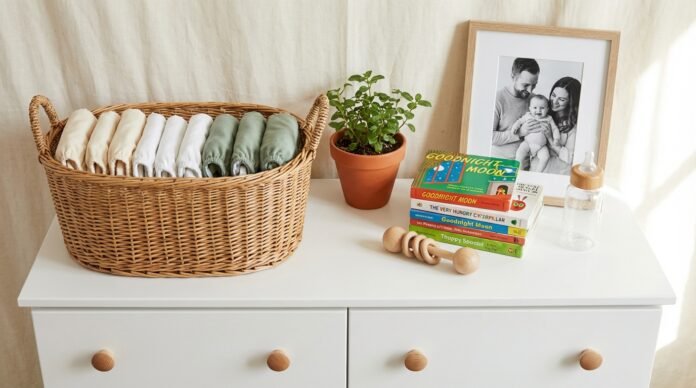
You remember the moment, don’t you? You’re standing in the baby superstore, maybe three months pregnant, and a cheerful salesperson shows you the “Complete Nursery Package” – crib, dresser, glider, bedding set – neatly displayed behind a sign that reads $2,999. Your stomach drops. You nod politely, take the brochure, and walk out wondering if you’ve already failed at this parenting thing before your baby has even arrived.
Here’s the truth that marketing department doesn’t want you to hear: That $3,000 nursery isn’t safer, better, or more loving than a $500 one. According to BabyCenter’s 2025 survey, the average family spends about $1,352 on nursery setup . But here’s what else their data shows: nearly 90% of moms say finances impact their mental health, and a quarter of families are downsizing their plans because of cost pressures .
This article isn’t about cutting corners. It’s about spending smart, knowing where your dollars actually matter for safety, and creating a space so beautiful and intentional that no one will ever guess you furnished it for pocket change. I’ve set up three nurseries on increasingly tight budgets, and the last one – a tiny room furnished almost entirely from Facebook Marketplace and IKEA – was my favorite. Let me show you how.
The Philosophy: Beautiful Doesn’t Mean Expensive
Before we dive into strategies, let’s reframe how you’re thinking about this project. A nursery is not a catalog spread. It’s a room where you will feed, change, comfort, and bond with your baby. Your baby will not notice whether the dresser cost $800 or $80. They will notice whether you’re present, whether you’re calm, and whether the space feels safe and warm.
The baby industry spends billions convincing you that love translates to spending. It doesn’t. What translates to love is intention – the carefully chosen secondhand find you painted yourself, the bookshelf you arranged at their eye level, the rocking chair where you’ll spend countless middle-of-the-night hours.
Let’s start with the non-negotiables.
Strategy 1: The “Safety First, Splurge Never” Rule
Here’s where we separate what you must buy new from what you can safely buy used. This distinction comes directly from the American Academy of Pediatrics and the Consumer Product Safety Commission, and getting it right could save your baby’s life.
What You MUST Buy New
The mattress. According to the AAP’s safe sleep guidelines updated in 2025, your baby needs a firm, flat sleep surface that doesn’t indent when they’re lying on it . A used mattress may have sagging you can’t see, mold from unknown accidents, or simply not fit snugly in your crib. This is a $50-$100 purchase that matters enormously.
The car seat. Never, ever buy a used car seat unless you personally know its complete history and can verify it’s never been in a crash. Even then, many experts advise buying new. Car seats expire, they’re often recalled, and microscopic damage from an accident isn’t visible.
The crib mattress pad and sheets. These are inexpensive and should be fresh.
What You Can Buy Used (and Save Hundreds)
The crib itself. Here’s what might surprise you: the CPSC safety standards for cribs changed significantly in 2011, banning drop-side cribs and tightening manufacturing requirements . Any crib manufactured after 2011 meets current safety standards. According to Consumer Reports, crib safety testing focuses on structural integrity, mattress support, and finish quality – all things you can inspect in person . Their 2025 top picks include a range from $150 to $400, but they also note that older, post-2011 cribs in good condition perform identically to new ones .
The dresser. Solid wood dressers from the 1980s and 1990s are often better constructed than anything you’d buy new for under $500. The key safety consideration is anchoring it to the wall to prevent tip-overs – which you should do with any dresser, new or old.
The glider or rocking chair. These are plentiful on the secondhand market because babies outgrow them quickly. Look for sturdy construction and removable, washable cushion covers.
Estimated savings: $200-$500 on furniture alone.
Strategy 2: Mastering the Secondhand Market (Without Getting Scammed)
Facebook Marketplace, Craigslist, and Buy Nothing groups are goldmines for nursery furnishings. But you need a system.
What to Look For
Search for “IKEA crib,” “DaVinci crib,” “Babyletto crib” – these brands are well-made, meet safety standards, and hold up well to multiple children. The IKEA SNIGLAR crib, for example, regularly sells used for $40-$60. It’s the exact same crib that Consumer Reports has tested and found perfectly safe .
Look for solid wood dressers. Particle board doesn’t travel well and won’t survive multiple moves. Solid wood can be painted, stained, or refreshed endlessly.
What to Avoid
Drop-side cribs manufactured before 2011. Check the manufacturer date on the crib label. If there’s no label, walk away.
Cribs with missing hardware. Replacement parts are nearly impossible to find, and cribs need every single bolt and screw to be safe.
Cribs with chew marks or excessive wear. If a previous teether has been at work, the finish is compromised.
How to Inspect
According to recent safety guidance, check that the mattress fits snugly – you shouldn’t be able to fit more than two fingers between the mattress and crib frame . Jiggle the crib. Does it wobble? Are all connections tight?
For dressers, open every drawer. Do they slide smoothly? Is the back panel attached securely? When you pull the top drawer out halfway, does the dresser tip forward? If so, you’ll need to anchor it immediately.
Safety on Marketplace
Scams are real. Retail experts advise using cash only for local transactions and never clicking links sent by buyers or sellers claiming to “verify your identity” . Meet in well-lit public places or bring someone with you to pick up larger items.
The Buy Nothing Goldmine
Your local Buy Nothing Project group on Facebook is where neighbors give away items for free. Post what you’re looking for. You’ll be amazed at how many people are eager to pass along gently used baby gear to a grateful new parent. I’ve seen $300 gliders given away simply because someone wanted them to go to a good home.
Estimated savings: $300-$600 if you furnish the entire room secondhand.
Strategy 3: The IKEA Hack Nursery
If there’s a universal truth among budget-conscious parents, it’s this: IKEA is your friend. The Swedish furniture giant makes cribs that meet all U.S. safety standards at prices that undercut almost everyone else.
The Stars of the Show
The SNIGLAR crib retails for around $79 new. It’s simple, solid pine, and converts to a toddler bed. Consumer Reports has tested IKEA cribs and found them perfectly adequate for safety and durability . Why pay $400 when $79 does the exact same job?
The TARVA dresser is a bare wood six-drawer dresser for around $149. It’s solid pine, not particle board, which means it can be painted, stained, or left natural. It’s wide enough to hold a changing pad on top, making it a perfect changing table that converts back to a regular dresser when diapering days are done .
The RASKOG cart ($45) is the unsung hero of nursery organization. Add small wicker baskets to each tier, and you have a mobile diaper station that rolls wherever you need it .
Simple Hacks That Look Expensive
Swap the knobs. The standard TARVA knobs are fine, but replacing them with brass or ceramic pulls from Etsy or a hardware store transforms the whole piece. Twenty dollars and fifteen minutes of work yields a dresser that looks custom.
Add legs. Many IKEA hacks involve adding wooden hairpin legs to dressers or storage units to elevate them off the floor . This costs about $20-$30 and gives pieces a mid-century modern feel.
Paint with intention. The TARVA takes paint beautifully. A soft sage green or warm terracotta costs $15 in sample paint and turns a basic dresser into a statement piece .
Cane webbing. Adding cane webbing to drawer fronts or cabinet doors gives an instant boutique nursery look. You can buy sheets online for $15-$20 and attach with strong adhesive .
Estimated savings compared to “boutique” furniture: $400-$800.
Strategy 4: DIY Decor That Looks Expensive (But Isn’t)
Here’s where your nursery goes from “budget” to “beautiful” – and where you get to infuse your personality into the space.
No-Sew Crib Skirt
Buy a twin-sized flat sheet in a fabric you love. Iron it. Use fabric tape or stitch witchery to hem the edges to your desired length. Slide it between the mattress and crib frame. Total cost: $10-$15, and it looks custom.
Onesie Art
Remember those cute onesies your baby will outgrow in approximately six minutes? Buy a pack of inexpensive embroidery hoops ($1 each at craft stores). Stretch a onesie over the hoop, trim the excess, and hang on the wall. When you want to change the art, swap in a new onesie.
Removable Wallpaper Accent Wall
Peel-and-stick removable wallpaper has become affordable and accessible. One roll ($25-$40) covers an accent wall and transforms the entire room. The best part? When your toddler decides they hate elephants and love dinosaurs, you can peel it off and start over .
Fabric Canopy
A length of gauzy fabric draped over a simple embroidery hoop or tension rod creates a dreamy canopy above the changing table or reading corner. Total cost: $15-$20.
Command Hook Curtains
Use command hooks to hang lightweight curtains without drilling. This is a renter’s best friend and takes ten minutes .
Estimated savings compared to buying “nursery decor”: $150-$300.
Strategy 5: The Minimalist Philosophy – What You Can Actually Skip
Let’s talk about the baby industry’s greatest trick: convincing you that you need dozens of items you absolutely do not.
According to the AAP’s safe sleep guidelines, a crib should contain exactly three things: a firm mattress, a fitted sheet, and your baby . That’s it. No bumpers (they’re suffocation risks and actually banned in some states), no blankets (use a wearable sleep sack instead), no pillows, no stuffed animals.
The Actual Essentials
- A safe sleep space (crib, bassinet, or play yard that meets CPSC standards)
- A changing surface (can be a dresser with a changing pad, doesn’t need to be a specialized table)
- A comfortable place to feed (could be the glider you found used, could be your bed with good pillows)
- Storage for clothes and diapers
- Blackout curtains (these are surprisingly affordable and make a huge difference)
What You Can Skip or Buy Later
- Wipe warmers (babies survive cold wipes, and these are notorious for drying out wipes)
- Diaper pails (a regular trash can with a lid and a deodorizing disc works fine)
- Bedding sets (you’ll use the fitted sheet and maybe the receiving blankets; the quilt and bumper are unsafe for sleep anyway)
- Specialized nursery furniture (regular furniture works perfectly well with the right accessories)
- Nursery-specific decor (regular art, framed prints, and personal items are often cheaper and more meaningful)
Estimated savings: $200-$400.
Strategy 6: Borrow, Don’t Buy
Here’s a radical idea: ask for help. Your community wants to support you.
Post on social media: “We’re setting up our nursery and would love to borrow or gently borrow any baby gear you’re not using!” You’ll be surprised. Friends who are done having kids are often eager to clear out their basements. Cousins with older children have bins of baby clothes they’re saving for “someday” – someday can be now.
How to Ask Gracefully
Be specific: “Does anyone have a bassinet we could borrow for the first few months?” or “We’re looking for a glider if anyone has one gathering dust.” Offer to pick up, promise to return in excellent condition, and follow through.
When you return items, include a small gift – a bottle of wine, a plant, a heartfelt note. You’re building a village, not just borrowing things.
The Hand-Me-Down Train
Accept everything. Sort through it later. Pass along what you don’t need to the next expecting parent. This is how communities have raised children for millennia – long before the baby industry convinced us we needed everything new.
Estimated savings: Priceless, but easily $300-$500 if you borrow major items.
Strategy 7: Timing Your Purchases
If you’re buying some items new, timing matters.
The Best Sales
- Amazon Prime Day (July) and Prime Big Deal Days (October): Good for diapers, wipes, and some gear
- Black Friday/Cyber Monday: The absolute best time to buy cribs, dressers, and car seats. Retailers discount deeply to draw you in.
- Target Circle Days: Regular 20% off baby gear promotions
- End-of-season clearance: Buy next year’s winter clothes in February, summer clothes in August
Use Price Tracking
CamelCamelCamel tracks Amazon price history. Before you buy, check whether the current price is actually a deal or just marketing. Many “sales” are simply bringing the price back down to normal after artificially inflating it.
The Registry Completion Discount
Here’s a little secret: create a registry at Target, Amazon, or Buy Buy Baby (now reopening stores). Even if you don’t share it, you’ll get a 15% completion discount on remaining items as your due date approaches. Use this for anything you’re buying new.
Estimated savings: 15-30% on new purchases.
Strategy 8: The Month-by-Month Plan
Spreading out purchases prevents the dreaded $2,000 nursery bill arriving all at once.
Month 4-5: Research. Join Buy Nothing groups. Start watching Marketplace for cribs and dressers.
Month 5-6: Buy the big furniture pieces. These take time to find used or to assemble.
Month 6-7: Paint if you’re painting. Shop for glider.
Month 7-8: Buy the mattress new. Gather bedding, curtains, storage solutions.
Month 8-9: Decor and organizing. Wash all clothing and bedding. Install car seat base.
Month 9: Final touches. Pack hospital bag. Relax.
A Note on Safety from the Experts
Let me synthesize what the authoritative sources say, so you can feel confident in your choices:
The American Academy of Pediatrics emphasizes that a safe sleep environment is firm, flat, and bare . This guidance is consistent across all settings and hasn’t changed because the evidence is clear. The CPSC maintains updated recall lists on their website – check any used crib against these lists .
The JPMA certification on new products means they’ve been tested by accredited labs to meet safety standards . For used items, you become the inspector.
Consumer Reports notes that price and safety don’t correlate . Expensive cribs aren’t safer – they’re just fancier. The $79 IKEA crib meets the same federal standards as the $800 Pottery Barn crib.
Real Parents, Real Savings
When I was pregnant with my first, I spent weeks agonizing over a $1,200 crib. I read every review, visited every store, and nearly talked myself into financing it. My second baby slept perfectly in a $150 IKEA crib we bought used for $60. The lesson wasn’t that I loved my second less – it was that I’d finally understood what mattered.
A friend of mine furnished her entire nursery for $275: a Facebook Marketplace dresser ($40), a Buy Nothing glider (free), an IKEA crib bought new with a registry discount ($65), and a changing pad from Target ($25). The rest went to paint, curtains, and decor. Her nursery is stunning – soft gray walls, brass accents, a gallery wall of family photos. No one would guess it cost less than some people spend on a single piece of furniture.
Another mom in my parenting group found a solid wood dresser on the curb with a “free” sign. She sanded it, painted it pale pink, and added crystal knobs from a thrift store. It’s the most beautiful piece in her daughter’s room.
The Bottom Line
The USDA estimates that middle-income families will spend over $240,000 raising a child born in 2013 . That number is higher now. But here’s what that report also shows: the biggest expenses are housing, food, and childcare – not nursery furniture.
BabyCenter’s 2025 data confirms that nursery setup is a relatively small piece of the first-year budget, which averages around $20,000 including childcare . But small doesn’t mean insignificant – especially when you’re also facing medical bills, potential leave without pay, and the daily costs of keeping a tiny human alive.
Here’s what I want you to take away: Your baby will never know what you spent. They will know whether you held them. They will know whether you sang to them. They will know whether you were present or stressed, calm or anxious.
If you spend $3,000 on a nursery but lie awake worrying about money, that room hasn’t served its purpose. If you spend $300 and feel peaceful, creative, and excited to be there at 3 AM, you’ve built something far more valuable.
Your First Steps Checklist
Feeling overwhelmed? Start here:
- Join your local Buy Nothing group on Facebook and introduce yourself as an expecting parent.
- Set up saved searches on Facebook Marketplace for “IKEA crib,” “baby glider,” and “nursery dresser.”
- Check the CPSC recall database for any used items you’re considering.
- Create a baby registry at a store offering a completion discount, even if you don’t share it.
- Make a list of exactly what you need – and stick to it. When you see something cute but unnecessary, ask yourself: “Will this matter at 3 AM?”
- Tell everyone you know that you’re setting up a nursery and welcome hand-me-downs.
The most beautiful nurseries I’ve ever seen weren’t the expensive ones. They were the ones with love in every corner – the hand-painted mural, the books passed down from grandparents, the glider where a mother and father took turns walking their baby back to sleep.
Build that nursery. Build it with intention, creativity, and community. Build it without guilt or shame about your budget.
Your baby is waiting. And they already think you’re perfect.
*Sources: American Academy of Pediatrics Safe Sleep Guidelines (2025) ; U.S. Consumer Product Safety Commission; Consumer Reports Crib Testing (2025) ; BabyCenter First-Year Cost Survey (2025) ; USDA Cost of Raising a Child Report ; Interviews with parenting and design experts.*