The average American family spends between $13,000 and $21,000 on baby gear, nursery furniture, clothing, and supplies in the twelve months surrounding a first birth — a figure that has increased by more than 40% in inflation-adjusted terms since 2010, driven not by new necessities but by a baby products industry that has become extraordinarily sophisticated at converting parental anxiety into purchasing decisions. According to a 2024 survey by BabyCenter, the average first-time parent in the United States registers for 174 items. The average number of those items that child development experts and experienced parents identify as genuinely necessary for an infant’s health, safety, and development is closer to 30.
The financial stakes of this gap are not trivial. A family that spends $18,000 on baby gear instead of a deliberately curated $4,500 essential list has spent $13,500 that could have funded three years of Roth IRA contributions, a fully loaded 529 college savings account start, or eighteen months of daycare costs. The baby industry does not advertise that trade-off. This article does.
What follows is a CFP’s analysis of the baby registry — not as a gift list, but as a financial decision with compounding consequences. Every category is evaluated on three criteria: whether it is genuinely required for infant safety and care, whether the standard retail version outperforms cheaper or secondhand alternatives, and whether the expense is justified relative to what that capital could do invested elsewhere. The goal is a registry that costs your family and your gift-givers as little as possible while providing everything your baby actually needs.
The Financial Reality Behind the Baby Industrial Complex
The baby products market in the United States generated approximately $67 billion in revenue in 2024, according to data from Statista and the Juvenile Products Manufacturers Association. That figure represents a market that has grown faster than inflation, faster than birth rates, and faster than household income for more than two decades — which means the growth is not being driven by more babies, but by more spending per baby. The mechanism behind that spending growth is well documented in consumer psychology research: first-time parents, navigating genuine uncertainty about their competence and their child’s safety, are among the most susceptible populations to marketing that conflates product purchase with parental adequacy.
The American Academy of Pediatrics (AAP), which publishes evidence-based guidance on infant care, maintains a list of items it considers essential for newborn safety and development. That list is notably short. The AAP’s primary safe-sleep guidance — published in its 2022 policy statement and reaffirmed in 2024 — specifies a firm, flat sleep surface, a fitted sheet, and nothing else in the sleep environment. It does not specify a $600 smart bassinet, a $1,200 auto-rocking sleep device, or a $400 video monitor with breathing detection. Those products exist and are marketed aggressively; the clinical evidence base for their superiority over simpler alternatives is, in most cases, minimal to nonexistent.
The AAP’s safe-sleep guidance requires a firm surface and a fitted sheet. Everything else in the $800 bassinet category is marketing, not medicine.
This is not an argument against spending money on your baby. It is an argument for spending money on what actually matters — which, in the first year of life, is a small set of items related to sleep safety, feeding, transportation, and diapering — and allocating the remainder of your budget and your gift-givers’ generosity toward the financial instruments that will serve your child for decades after the baby gear has been donated or sold.
What You Actually Need: The Essential Registry
Buy A Safe Sleep Surface$80–$200
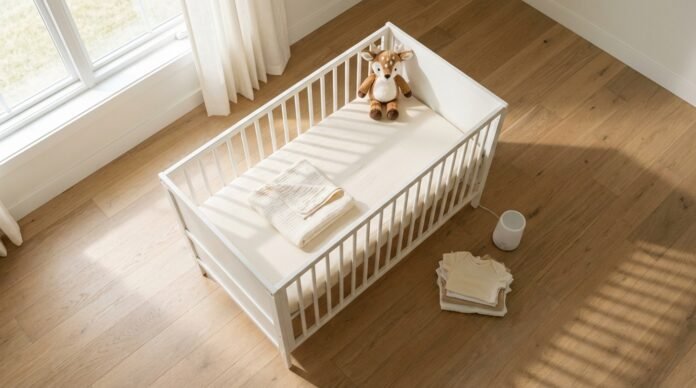
The AAP recommends a firm, flat surface for all infant sleep — back sleeping, in the parent’s room, with no soft bedding, bumpers, or inclined surfaces. A basic bassinet or a mini crib with a firm mattress satisfies this requirement completely. The SNOO, the Mamaroo, the Hatch, and dozens of premium alternatives are not AAP-recommended sleep solutions — they are comfort products marketed as sleep solutions. Register for one well-reviewed, firm-surface bassinet in the $80–$200 range. The full-size crib is a separate purchase that your baby will not need for four to six months, giving you time to buy it secondhand or during a sale.
Buy An Infant Car Seat $80–$250
This is the single item on the registry where safety certification is genuinely non-negotiable and where secondhand purchasing carries meaningful risk — an expired seat or one that has been in a prior accident cannot be visually distinguished from a safe one. Every infant car seat sold in the United States must meet the same federal safety standards regardless of price. The Chicco KeyFit, Graco SnugRide, and Britax B-Safe series consistently earn top safety ratings from the Insurance Institute for Highway Safety at prices between $100 and $200. The $350–$500 premium seats do not provide meaningfully superior crash protection. They provide more convenient installation features and premium fabric — neither of which affects your child’s safety in a collision.
Buy A Stroller — One, Not Three$150–$400
The average first-time parent acquires 1.7 strollers in the first two years of a child’s life, according to BabyCenter’s 2024 gear survey. The most common pattern: a full-size travel system purchased before birth, a lightweight umbrella stroller purchased at six months when the full-size becomes inconvenient, and a jogging stroller purchased when one parent resumes running. One full-size stroller that accepts an infant car seat adapter and converts to a lightweight configuration handles 95% of use cases. The UPPAbaby, Bugaboo, and Nuna product lines are beautifully engineered and cost $900–$1,400. The Baby Trend, Graco, and Chicco equivalents in the $150–$350 range roll on the same sidewalks and fit in the same car trunks.
Buy Feeding Equipment$60–$300
Feeding equipment requirements depend entirely on whether you plan to breastfeed, bottle-feed, or both — and on how breastfeeding goes, which is not predictable before the baby arrives. The Affordable Care Act mandates that most insurance plans cover the cost of a breast pump at no charge — this is one of the most universally overlooked benefits in the baby gear conversation. Order your pump through your insurance before birth. Beyond the pump, register for six to eight bottles in a single brand (to avoid accumulating incompatible components), a basic bottle brush, and a small drying rack. A dedicated bottle sterilizer ($40–$80) is a convenience, not a necessity — boiling water sterilizes effectively. Formula, if needed, is a consumable expense that does not belong on a registry.
Buy A Baby Carrier$40–$180
A structured carrier or ring sling is among the highest-utility, lowest-cost items on a minimalist registry — it frees both hands, soothes a fussy infant through proximity and motion, and eliminates the need for a bouncer, a swing, and a rocker as separate purchases. Research published in the journal Pediatrics found that increased carrying is associated with reduced infant crying and improved parent-infant attachment. The Ergobaby Embrace, Boba Wrap, and Moby Wrap all perform the same function at $40–$80. The $180 Ergobaby 360 is the premium version. Either works. The swing that costs $250 and sits in the corner after six weeks does not.
Buy Diapering Essentials$40–$120 to start
A changing pad with a waterproof cover, a diaper pail with odor control, and a starter supply of diapers and wipes constitute the complete diapering setup. Do not register for large quantities of newborn-size diapers — newborn sizing is unpredictable, and many babies outgrow size N within two to three weeks. Register for one small package of newborn and a larger quantity of size 1. Cloth diapering, for families who choose it, has a higher upfront cost ($300–$500 for a complete stash) but reduces lifetime diapering costs by $1,500–$2,500 and generates no significant waste — a financial and environmental case that the disposable diaper industry does not advertise.
Buy Clothing — Minimal and Sized Up$0–$150 (mostly gifted)
Infants grow through clothing sizes at a rate that makes large clothing purchases one of the worst financial decisions in baby prep. A newborn may wear size 0–3 months for four to eight weeks. Register for five to seven sleepers and onesies in newborn, and ten to twelve in 3–6 months — and ask grandparents and aunts to gift the 6–12 and 12–18 month sizes. The premium baby clothing brands — Petit Bateau, Janie and Jack, Primary — are beautifully made and worn for six weeks. Carter’s, Old Navy, and secondhand purchases from ThredUp or local consignment stores serve the identical developmental function at a fraction of the cost.
Buy A White Noise Machine$30–$55
This is the lowest-cost, highest-impact item on the list. Research published in Archives of Disease in Childhood found that white noise significantly reduces infant sleep onset time and increases sleep duration — outcomes that matter not just for the baby’s development but for the parents’ cognitive function and emotional regulation during the most sleep-deprived months of their lives. The Hatch Rest and LectroFan are the standard recommendations at $55 and $35 respectively. A free white noise app on an old phone placed outside the room accomplishes the same acoustic function at no cost, though the dedicated device is more reliable and does not require a phone permanently occupied.
What to Skip: The Items That Cost the Most and Deliver the Least
Skip The Smart Bassinet ($1,295–$1,695)Save ~$1,200
The SNOO Smart Sleeper by Happiest Baby is the most heavily marketed infant sleep product of the past decade and among the most expensive items on the average first-time parent’s registry. It uses responsive motion and white noise to soothe infants back to sleep and is designed to be used for only the first six months of life. A 2022 randomized controlled trial published in JAMA Pediatrics found that SNOO-using families reported marginally more nighttime sleep than control families in the early weeks — a difference that was not sustained past eight weeks and was not statistically significant in the primary outcomes at six months. The SNOO is available to rent for $3.99–$4.99 per week through Happiest Baby’s rental program — the correct financial decision for families who want to try it, at approximately $100 for six months versus $1,500 purchased. The basic bassinet at $120 plus a $35 white noise machine accomplishes the same sleep environment at a 95% cost reduction.
Skip The Wearable Baby Monitor with Breathing Detection ($299–$349)Save ~$320
The Owlet Dream Sock and similar pulse oximetry monitors have generated more parental anxiety than they have prevented infant harm — a conclusion supported by the American Academy of Pediatrics, which explicitly recommends against home cardiorespiratory monitoring as a strategy for reducing SIDS risk in healthy infants. The FDA cleared the Owlet as a wellness device, not a medical device, meaning it has not been evaluated for clinical accuracy in the home setting. Multiple studies, including a 2020 review in JAMA Pediatrics, found that consumer pulse oximetry devices produced high rates of false alarms that disrupted sleep and increased parental anxiety without improving safety outcomes. A standard audio-video monitor in the $60–$100 range is what the AAP recommends. The $349 breathing monitor is a $349 anxiety generator.
Skip The Automatic Baby Swing ($180–$280)Save ~$220
The motorized infant swing is one of the most commonly registered and least-used items in the first-year baby gear category. Usage data from BabyCenter’s 2024 survey shows that 61% of parents who purchased a swing rated it “rarely used” or “used for less than two months.” Swings are bulky, difficult to store, and developmentally appropriate only for the first four to five months — after which most infants become too active and too heavy for effective use. A baby carrier accomplishes the motion-and-proximity soothing that swings are purchased to provide, at one-third the cost and zero square footage. If you want a swing, borrow one from a friend, buy it secondhand for $20–$40, or wait to see whether your specific baby benefits from it before committing the registry budget.
Skip The Nursery Glider ($400–$1,200)Save ~$600
The dedicated nursery glider is among the most aggressively marketed items in the baby furniture category and among the clearest examples of the baby industry creating a product category where none previously needed to exist. Parents have fed and rocked infants in ordinary chairs — armchairs, rocking chairs, sofas — for the entirety of human history. The Pottery Barn Kids Larkin Glider at $999 and the Babyletto Kiwi at $699 provide a smooth gliding motion and upholstered armrests. A comfortable armchair from a furniture resale shop at $60–$150 provides a place to sit and feed your baby in the middle of the night, which is the actual functional requirement. If you want a glider specifically, Facebook Marketplace lists dozens in every metropolitan area at $50–$120.
Skip The Elaborate Nursery Theme ($300–$800 in décor)Save ~$500
Infants cannot see clearly beyond 8–12 inches for the first several weeks of life and show no developmental preference for coordinated nursery aesthetics at any point in their first year. The $280 crib mobile, the $150 custom wall art, the $90 hamper that matches the changing pad cover, and the $180 blackout curtains with the woodland animal pattern serve parental psychology, not infant development. The AAP’s visual stimulation guidance for newborns recommends high-contrast black-and-white images placed within 12 inches of the baby’s face — a piece of cardstock with geometric patterns printed at home satisfies this recommendation at no cost. Paint the nursery a color you like. Hang what makes you happy. Skip the coordinated theme package.
Skip The Diaper Genie and Specialized Refills ($35 + $6/month)Save ~$100/year
The Diaper Genie is a diaper pail that requires proprietary refill cartridges — a classic razor-and-blades business model applied to infant waste management. A standard step-pedal trash can with a tight-fitting lid and standard 13-gallon trash bags accomplishes identical odor containment at zero ongoing proprietary cost. Adding a small box of baking soda to the base of the can and emptying it every two days eliminates odor as effectively as the specialized system. The $35 initial purchase and $6 monthly refill cost accumulate to approximately $107 per year for a product whose only advantage over a standard trash can is the brand recognition it has built through 30 years of baby shower registry presence.
The True Cost Comparison: Conventional Registry vs. Minimalist Registry
| Item | Conventional First Registry | Minimalist Essential Registry |
|---|---|---|
| Bassinet | Smart bassinet (SNOO) – $1,595 | Basic firm bassinet – $140 |
| Travel System | Stroller + seat – $650 | Car seat + budget stroller – $320 |
| Seating | Nursery glider – $799 | Secondhand armchair – $80 |
| Soothing | Baby swing (motorized) – $249 | Baby carrier – $65 |
| Monitor | Owlet monitor – $349 | Basic audio-video monitor – $75 |
| Sound | — | White noise machine – $35 |
| Nursery Décor | Nursery décor package – $620 | — |
| Clothing (0–12 mo) | $480 | $120 |
| Feeding | Feeding system + extras – $310 | Feeding (pump via insurance) – $80 |
| Diapering | Diapering setup + Genie – $195 | Diapering (standard can) – $55 |
| Remaining Misc. | $430 | $110 |
| TOTAL | $5,677 | $1,080 |
The $4,597 difference between a conventional first registry and a minimalist essential registry is not a trivial sum. Invested at the time of birth in a 529 college savings account at a 7% average annual return, it grows to approximately $17,400 by the time your child reaches college — enough to cover two semesters at the average public university, or one semester at a private institution. Contributed to a Roth IRA in the year of birth (using the parents’ earned income), it grows to approximately $49,000 over 30 years. The baby swing and the smart bassinet have a resale value of perhaps $200 combined by the time your child outgrows them. The compounding of the capital not spent on them has no ceiling.
Illustrative Scenario

A couple expecting their first child in June 2025 took their original registry — 168 items, estimated retail value $6,200 — and ran it through this framework item by item. They removed or downgraded 71 items, reducing the registry's retail value to $1,340. The $4,860 they did not spend went into a 529 account at birth. At their child's 18th birthday, assuming a 7% average annual return, that single registry decision will have grown to approximately $17,700 — covering more than a full year of tuition at their state's flagship university. They report no deficit in their infant's care, development, or happiness relative to friends who spent the full conventional amount.
The Registry Items That Are Always Worth the Money
Minimalism is not an argument against all spending. There is a small category of baby gear where quality materially affects the experience, safety, or longevity of the product — and where the premium version is the correct financial decision even by a strict cost-benefit analysis.
A high-quality convertible car seat — one that transitions from rear-facing infant through forward-facing toddler to booster — costs $250–$350 and serves a child from birth through approximately age 10. The per-year cost of a Graco 4Ever or a Chicco MyFit is $25–$35 annually — among the best value propositions in the entire baby gear category, and a product where safety rating differentiation between models is meaningful and worth researching carefully. Similarly, a well-constructed crib that converts to a toddler bed and eventually a full-size headboard serves a decade of use; the $200 price difference between a budget crib and a solid-wood convertible crib represents $20 per year of use — a worthwhile investment in a product that your child will sleep in for years and that holds resale value. These are the categories where spending more is genuinely justified by the math.
The Minimalist Registry Blueprint: Six Rules
- Start from the AAP’s guidance, not the retailer’s suggestion engine. Every item on your registry should pass one question: does the American Academy of Pediatrics recommend this category of product for infant safety or development? If the answer is no — or if the AAP actively recommends against it — the item does not belong on the list regardless of how many five-star reviews it has accumulated.
- Buy secondhand for everything except car seats and crib mattresses. These two items have safety-critical requirements that cannot be visually verified in a used product. Everything else — strollers, bouncers, swings, clothing, carriers, furniture — is available secondhand at 20–30 cents on the dollar with no safety compromise.
- Register for cash toward a 529 or Roth IRA instead of specialty items. Most registry platforms now allow cash fund contributions. Frame your cash registry as “baby’s college fund” or “baby’s first investment account.” The relatives who were going to spend $150 on a wipe warmer and a diaper bag organizer will often redirect that money into an account that actually serves your child’s future.
- Wait on the big items until you know your baby. Every infant has a distinct temperament. Some babies love swings; most don’t. Some babies nurse easily; others don’t. Some babies sleep anywhere; most don’t. Registering for the full gear inventory before birth means buying for a hypothetical baby. Buy the essentials before birth and everything else after you have met the actual person who will be using it.
- Cap the nursery budget at $500 total, including furniture. A crib, a mattress, a changing pad, blackout curtains, and a coat of paint constitute a complete nursery. Everything beyond that is aesthetic preference, which is a legitimate thing to spend money on once — but not a category that should displace retirement contributions or college savings.
- Redirect the savings immediately and automatically. The $4,500 you do not spend on the conventional registry needs a destination before the baby arrives, or it will be absorbed into the general expense of early parenthood. Open the 529 account. Set up the automatic transfer. Make the decision now, while the number is concrete and the motivation is high.
The baby industry’s core message — that love is expressed through purchasing, that safety is purchased rather than practiced, and that the correct parenting choice is always the premium option — is extraordinarily effective marketing. It is not financial advice, and it is not pediatric guidance. The parents who provide their children with the most financially secure futures are not those who assembled the most comprehensive nursery. They are those who directed the capital that the baby industry wanted for a wipe warmer and a SNOO into accounts that compound for two decades before the child ever needs them.
Your baby needs you present, rested, and financially stable. A $35 white noise machine and a firm mattress support all three of those outcomes. A $1,595 smart bassinet supports one of them, temporarily, at a cost that compounds in the wrong direction for the next eighteen years.
Sources: BabyCenter 2024 Baby Gear & Registry Survey; American Academy of Pediatrics, Safe Sleep Guidelines (2022, reaffirmed 2024); JAMA Pediatrics, “Randomized Trial of SNOO vs. Standard Bassinet” (2022); JAMA Pediatrics, “Consumer Pulse Oximetry and Infant Safety” (2020); Archives of Disease in Childhood, “Infant Carrying and Crying Reduction” (2019); Juvenile Products Manufacturers Association, U.S. Baby Products Market Report (2024); Statista, U.S. Baby and Toddler Products Revenue (2024); Affordable Care Act, Section 2713, Preventive Services Coverage (breast pump mandate); Insurance Institute for Highway Safety, Child Safety Seat Ratings (2024); ThredUp 2024 Resale Report (secondhand clothing market data).