The number most widely cited for the cost of raising a child in the United States — $310,605 from birth to age 17, published by the Brookings Institution’s updated analysis of USDA data — works out to approximately $18,271 per year on average. That figure is frequently quoted, rarely examined, and almost never broken down in a way that prepares expectant parents for what the first twelve months will actually cost. The first year is categorically different from subsequent years: it concentrates the medical costs of birth and newborn care, the one-time capital expenditure of all essential gear, the income disruption of parental leave, and the single largest new recurring expense — childcare — all within the same calendar year. For most families, year one costs two to three times the annual average.
A 2024 survey by NerdWallet found that 63% of first-time parents reported spending significantly more in their baby’s first year than they had anticipated — with the average reported gap between expected and actual spending exceeding $4,200. The sources of that gap are consistent across respondents: medical bills that arrived months after delivery, childcare costs that began the day leave ended, formula and feeding expenses that escalated when breastfeeding plans changed, and a continuous stream of gear purchases for developmental stages that no one told them were coming. These are not unpredictable costs. They are simply unbudgeted ones.
What follows is a category-by-category breakdown of every significant first-year expense, with low and high estimates for each line item, regional variance data for the costs that differ most by geography, and specific strategies for reducing each category without compromising your baby’s health, safety, or development. The goal is a complete picture before the bills arrive — not after.
Category 1: Medical Costs — Birth, Newborn Care, and the First Year of Pediatric Visits
Medical costs in the first year are the category most consistently underestimated by expectant parents, for a specific structural reason: the bills arrive on a three-to-six month delay after the services are rendered, by which point the psychological and practical chaos of early parenthood has obscured any advance planning that was done. A family that delivers in October may not receive the final reconciled bill from their hospital, their OB, their anesthesiologist, their pediatric hospitalist, and their newborn’s separate facility fee until February — six months later, when the family’s budget has already been restructured around the new childcare expense and the restored income from return-to-work.
Understanding the cost structure before delivery is therefore not an academic exercise — it is the only way to budget for it accurately. The average cost of a vaginal delivery in the United States in 2024, before insurance, was approximately $14,700 according to data from the Healthcare Cost Institute. The average cost of a cesarean section was approximately $26,300. After insurance, the family’s out-of-pocket exposure depends entirely on their plan’s deductible, out-of-pocket maximum, and in-network status of every provider involved in the delivery — including the anesthesiologist and the neonatologist, who are frequently out-of-network even when the delivering hospital is in-network.
The Surprise Bill Risk

The No Surprises Act of 2022 limits balance billing from out-of-network providers at in-network facilities for emergency care — but obstetric delivery is classified as scheduled care in most cases, meaning protections vary by state. Verify the network status of your anesthesiologist and any specialist who may attend the delivery before your due date. This single verification step prevents the most common source of unexpected four-figure medical bills in the birth year.
Line Item
Notes / Assumptions
Low Estimate
High Estimate
Hospital delivery (after insurance, OOP max)
Assumes in-network, plan OOP max applies to entire birth year
$800
$5,000
Anesthesiologist / epidural (potential OON gap)
Frequently out-of-network even at in-network hospitals
$0
$1,500
Newborn well-child visits (6 visits, year one)
Fully covered as preventive care under ACA if in-network
$0
$480
Sick visits and urgent care (2–4 visits)
Ear infections, RSV, respiratory illness common in year one
$120
$800
Prescriptions and OTC medications
Infant acetaminophen, saline, gas drops, teething remedies
$80
$220
Postpartum care (lactation consultant, pelvic floor PT)
Coverage varies; often partially reimbursed
$200
$1,200
Dental insurance premium increase (adding child)
Many employer plans charge incremental premium per dependent
$0
$300
Cost Reduction Strategy

The single most effective action to reduce medical costs in the birth year is confirming your health plan's out-of-pocket maximum and verifying it applies to both the birth parent and the newborn on the same policy. Many plans have separate individual and family out-of-pocket maximums — if your plan has a $4,000 individual OOP max and a $7,000 family OOP max, you may owe up to $3,000 for the newborn's care even after the birth parent has met their individual limit. Add your child to your insurance plan within 30 days of birth — this is a qualifying life event with no waiting period — and confirm in writing with your insurer that the newborn's birth hospitalization claims will be processed under the family policy retroactively to the date of birth.
Category 2: Childcare — The Expense That Changes Everything
Childcare is the largest single new expense in the first year for the majority of American families with two working parents, and it is the expense most consistently excluded from first-year cost estimates because it begins only when parental leave ends — making it feel like a second-year problem rather than a first-year one. It is not. For a family whose leave ends at twelve weeks and whose baby turns one at fifty-two weeks, childcare is a first-year expense for forty weeks — ten months — of the first year of life. At the median urban infant care cost of $1,800 per month, that is $18,000 in the first year alone.
The U.S. Department of Health and Human Services’ National Database of Childcare Prices documents the full range of infant center-based care costs by county. The national median for full-time infant center care is $1,230 per month, but that median conceals a distribution that runs from $650 per month in rural Mississippi to over $3,000 per month in San Francisco, Boston, and Washington D.C. Family daycare homes — where a licensed provider cares for a small group of children in a residential setting — typically cost 15–30% less than center-based care at equivalent quality levels and represent the most cost-effective licensed care option for most families.
Line Item
Notes / Assumptions
Low Estimate
High Estimate
Full-time infant center-based care (8 months)
National median; varies dramatically by region
$5,200
$24,000
Registration / enrollment fees
One-time fee charged by most centers
$75
$400
Dependent Care FSA tax savings (offset)
$5,000 election saves $1,100–$1,850 depending on tax bracket
−$1,100
−$1,850
Region / Metro
Monthly Cost
Annual (8 mo.)
Rural Midwest / South
$650–$900
$5,200–$7,200
Mid-size cities (Columbus, Louisville)
$950–$1,300
$7,600–$10,400
Large metros (Chicago, Atlanta, Dallas)
$1,400–$1,900
$11,200–$15,200
High-cost metros (NYC, LA, Seattle)
$2,000–$2,800
$16,000–$22,400
Top-cost markets (SF, DC, Boston)
$2,800–$3,500
$22,400–$28,000
Category 3: Feeding — Formula, Nursing Supplies, and the Transition to Solids
Infant feeding costs in the first year are among the most variable line items in the budget, determined primarily by two factors: whether the baby is breastfed, formula-fed, or combination-fed, and how smoothly the chosen method goes. A baby who breastfeeds exclusively and efficiently for twelve months, with a pump covered by insurance and no supplemental formula required, generates approximately $300–$600 in feeding-related costs for the year — lactation consultant fees, nursing bras, storage bags, and the electric pump not fully covered by insurance. The same baby fed exclusively on name-brand formula generates $2,400–$3,600 annually, before accounting for the formula shortage premium that drove name-brand prices up by an average of 18% between 2021 and 2024 according to the Bureau of Labor Statistics CPI data.
The transition to solid foods beginning at approximately six months adds a category that most first-year budgets omit entirely. Stage-one and stage-two jarred baby foods from Gerber or Beech-Nut cost approximately $1.00–$1.50 per 4-ounce jar; a baby eating solids twice daily consumes 2–3 jars per day, adding $60–$135 per month. Baby-led weaning — introducing soft, appropriately sized pieces of whole foods from the family’s meals — costs effectively nothing in incremental food budget and is endorsed by the American Academy of Pediatrics as nutritionally equivalent to puréed foods for developmentally ready infants over six months.
Line Item
Notes / Assumptions
Low Estimate
High Estimate
Breast pump
Covered at no cost by most insurance under ACA (confirm before purchasing)
$0
$350
Nursing supplies
Bras, pads, storage bags, nipple cream
$120
$280
Lactation consultant (1–3 sessions)
Often partially covered as preventive care
$0
$400
Formula (if formula-fed, full year)
Generic/store-brand reduces cost 30–40%
$0
$3,000
Bottles, nipples, sterilizing equipment
6–8 bottles + basic cleaning setup
$60
$180
Solid foods (6–12 months)
Baby-led weaning from family meals minimizes added cost
Category 4: Diapers, Wipes, and Diapering Supplies
The average infant uses approximately 2,700 diapers in the first year of life, based on typical usage rates of 8–10 diapers per day in the newborn period declining to 6–8 per day by twelve months. At the average retail price of $0.27 per diaper for store-brand disposables — which are nutritionally and functionally equivalent to name-brand diapers, according to Consumer Reports’ testing — the full-year disposable diapering cost is approximately $729. Name-brand diapers at $0.38–$0.45 per unit produce a first-year cost of $1,026–$1,215 for an identical diapering outcome. The entire difference between those figures — $300 to $500 — is brand margin, not performance.
Generic zinc oxide equivalent to branded options at ~½ cost
$40
$90
Changing pad cover (2–3) & changing table
Floor-level pad eliminates furniture cost entirely
$35
$220
Cloth diapering system (if chosen)
Higher upfront cost; saves $1,500–$2,500 over full diapering years
$300
$500
Category 5: Gear, Furniture, and One-Time Equipment
The gear category is addressed in detail in our companion article on the minimalist baby registry. For budgeting purposes, the relevant figures are the realistic total for a thoughtfully curated essential list versus the conventional first-time parent registry. The essential list — safe sleep surface, car seat, stroller, carrier, monitor, white noise machine, and basic nursery furniture — can be assembled for $900–$1,800 new, or $400–$900 with strategic secondhand purchasing for all items except the car seat and crib mattress. The conventional registry, assembled without a cost filter, routinely runs $4,500–$7,000 before gifts are applied.
Line Item
Notes / Assumptions
Low Estimate
High Estimate
Safe sleep surface (bassinet + crib)
Basic firm bassinet + convertible crib at 4–6 months
$220
$900
Infant car seat
All U.S. seats meet federal safety standards regardless of price
$80
$320
Stroller
Secondhand purchase can cut cost 60–70%
$80
$800
Baby carrier / wrap
Can replace swing, bouncer, rocker
$40
$180
Baby monitor (audio-video)
AAP does not recommend breathing-detection monitors for healthy infants
$60
$350
White noise machine
Lower-cost models perform comparably to premium units
$30
$80
Play mat & developmental toys (0–12 mo)
High-contrast basics serve same developmental purpose
$60
$380
Nursery furniture & décor
Secondhand reduces cost significantly
$100
$1,800
Bath supplies (infant tub + products)
Fragrance-free soap + basic infant tub sufficient
$40
$180
Misc. gear (nasal aspirator, thermometer, etc.)
Includes manual aspirator + rectal thermometer
$60
$200
Category 6: Clothing
Infant clothing is simultaneously the most over-purchased and most easily optimized category in the first-year budget. The developmental reality is blunt: a newborn outgrows size 0–3 months in four to eight weeks, size 3–6 months in six to ten weeks, and size 6–12 months across a broader range depending on the child’s growth trajectory. Premium baby clothing brands charge $18–$45 per onesie for garments worn for six weeks, laundered daily, and stained with a reliability that no fabric treatment fully resists. The functional requirement for infant clothing is: soft, flame-resistant, easy to put on a squirming person at 3 a.m., and available in sufficient quantity to absorb the laundry cycle. Carter’s, Old Navy, and secondhand purchasing from ThredUp, Poshmark, or local consignment stores satisfy all four criteria at $2–$8 per item.
Line Item
Notes / Assumptions
Low Estimate
High Estimate
Newborn & 0–3 month clothing
5–7 sleepers + 5–7 onesies; many received as gifts
$0
$150
3–6 month clothing
10–12 piece wardrobe; sizing up extends wear window
$40
$200
6–12 month clothing
Secondhand at $2–$4 per item is most cost-efficient
$60
$350
Shoes (crawling / early walking)
Barefoot or soft sole until independent walking
$20
$120
Sleep sacks (3–4 total)
Swaddle alternative; rotating sizes through the year
$40
$140
Category 7: Income Disruption During Parental Leave
The income disruption cost of parental leave is rarely included in first-year baby cost estimates, despite being one of the largest financial events of the entire year. A family that takes twelve weeks of leave — eight weeks paid, four weeks unpaid — at a household income of $90,000 loses approximately $6,900 in gross income during the unpaid portion. After taxes, the take-home loss is approximately $5,100. That number is a first-year baby cost. It belongs in the budget.
The full framework for calculating leave income gap and preparing for it is covered in detail in our companion article on preparing for unpaid parental leave. For the purposes of the first-year cost total, the income disruption line item ranges from zero — for families in states with comprehensive paid family leave who also have employer-paid leave — to $15,000 or more for dual-income families in states without paid leave whose employers provide no paid leave benefit beyond FMLA’s unpaid job protection.
Line Item
Notes / Assumptions
Low Estimate
High Estimate
Net income lost during unpaid leave
Zero in states with full paid leave + employer coverage; varies by state and employer policy
$0
$15,000
The Complete First-Year Budget: Total Cost Summary
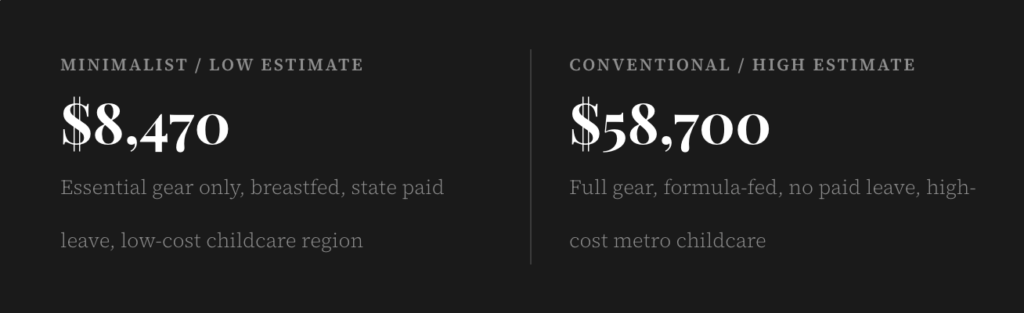
The $50,000 spread between those two figures is not a margin of error — it is a direct measure of the decisions families make and the circumstances they find themselves in. Childcare geography alone accounts for $19,000 of the gap. Income disruption during leave accounts for up to $15,000. Gear and registry choices account for $4,600. Formula versus breastfeeding, $2,800. Every one of those variables is either partially within a family’s control or at minimum foreseeable — which is the entire point of building a detailed budget before the baby arrives rather than after.
The $50,000 spread between a minimalist and conventional first year is not luck. It is the accumulated result of specific decisions made — or not made — before the baby arrives.
Illustrative Scenario

A couple in Chicago — a teacher earning $62,000 and a graphic designer earning $58,000 — built their first-year budget six months before their due date using this framework. Their estimate: $31,400, including $14,400 in center-based infant care (8 months), $6,200 in medical costs (cesarean delivery, high-deductible plan), $3,200 in gear and registry, $2,400 in formula (breastfeeding attempt for 3 months, then formula-fed), $1,600 in diapers and wipes, $800 in clothing, and $2,800 in income disruption during the father's 4 weeks of unpaid leave. Their actual first-year spending came in at $33,100 — $1,700 over their estimate, attributable entirely to two urgent care visits and an unexpected stroller replacement after a theft. They attributed the accuracy to category-level budgeting rather than a round-number estimate.
The First-Year Budget Blueprint: Six Rules
Build your first-year budget by category, not by round number.“We’ll probably spend around $20,000” is not a budget — it is a guess that will be wrong. The seven categories in this article each have specific, estimable line items. Total them individually. The accuracy that results is not a minor improvement over a round-number estimate; it is the difference between bill shock and financial preparedness.
Verify your health insurance out-of-pocket maximum structure before your due date.Confirm whether your plan has separate individual and family maximums. Confirm the network status of every provider who may be involved in your delivery, including the anesthesiologist. Confirm how and when to add the newborn to your policy. These three verifications prevent the most common sources of unexpected four-figure medical bills in the birth year.
Max your Dependent Care FSA during open enrollment — it reduces your effective childcare cost by 22–37% depending on your tax bracket.The $5,000 household maximum, run through a 27% combined federal and state tax rate, saves $1,350 in taxes on childcare you were going to pay anyway. This is the highest-return administrative action available to working parents with childcare expenses.
Budget the income disruption of parental leave as a first-year cost, not a separate event.Calculate your precise leave income gap using the framework in our companion article and include it as a line item in the first-year budget. A family that plans for $0 in income disruption and experiences $8,000 in income disruption has not experienced an unforeseeable emergency — they have experienced a foreseeable event they chose not to budget for.
Use the low estimate as your target and the high estimate as your contingency ceiling.Build your first-year savings goal around the low estimate for each category — essential gear, store-brand diapers, secondhand clothing, generic formula if needed. Hold the difference between the low and high estimates as an accessible contingency fund, not as pre-authorized spending. If you do not need the contingency, invest it.
Redirect every dollar saved vs. the conventional first-year budget into a 529 or Roth IRA immediately.The $4,600 you save by building a minimalist registry rather than a conventional one, invested at birth in a 529 account, grows to approximately $17,500 by the time your child reaches college at a 7% average annual return. Name that money before the baby arrives, or it will disappear into the general cost of early parenthood without a trace.
Bill shock in a baby’s first year is not a consequence of having a baby. It is a consequence of not knowing, in advance and in detail, what having a baby costs. Every figure in this article was knowable before your due date. The families that experience the first year as a financial crisis are not those who spent more — they are those who planned less. The two variables are not the same, and only one of them is within your control.
Sources: Brookings Institution / USDA, updated Cost of Raising a Child analysis (2024); NerdWallet, First-Year Baby Cost Survey (2024); Healthcare Cost Institute, U.S. Hospital Delivery Cost Data (2024); U.S. Department of Health and Human Services, National Database of Childcare Prices (2024); Bureau of Labor Statistics, CPI Infant Formula Price Index (2024); Consumer Reports, Disposable Diaper Brand Testing (2023); American Academy of Pediatrics, Safe Sleep Guidelines and Feeding Recommendations (2024); USDA Food and Nutrition Service, WIC Program Data (2025); No Surprises Act implementation guidance, Centers for Medicare & Medicaid Services (2024); IRS Publication 503, Dependent Care FSA rules (2024); Care.com 2024 Cost of Care Survey; Pew Research Center, Parental Leave in the U.S. (2023).
You know the feeling. You're sitting at your desk, pretending to focus on spreadsheets, but your mind is elsewhere—on the baby who woke up four times last night, on the daycare bill that just arrived, on the nagging question:...
You know that thing you do when you finally get a moment to yourself? Maybe you knit while the baby naps. Maybe you bake when the house is finally quiet. Maybe you take photos of your kids that friends...
You've done it. You found $500 in your monthly budget—maybe from refinancing the mortgage, cutting unused subscriptions, or that raise you finally asked for. Now comes the hard part: what to do with it.
If you're like most parents, you...
Enjoy exclusive access to all of our content
Get an online subscription and you can unlock any article you come across.