
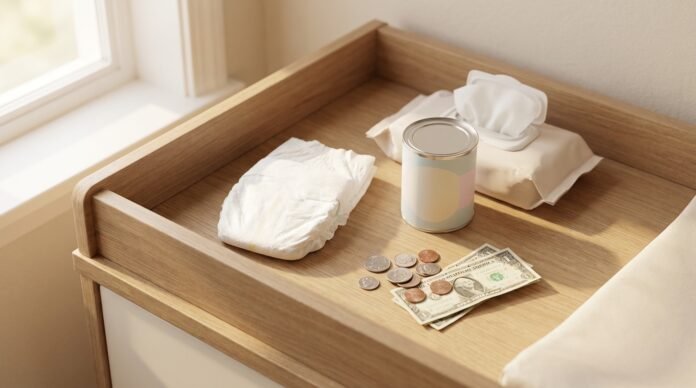
There’s a moment that happens to almost every new parent, usually around week six. The fog of sleep deprivation briefly lifts, you open your banking app for the first time in a while, and you stare at what you’ve spent on diapers and formula with something between disbelief and mild horror. You knew it would be expensive. You didn’t quite know it would be this expensive.
Here’s the reality check: according to BabyCenter’s 2025 research, the total first-year cost of raising a baby has climbed to $20,384 — a staggering 29% jump from $15,775 just three years earlier in 2022. And within that number, diapers and formula quietly devour a larger share than most parents anticipate before the baby arrives.
This article breaks down exactly where that money goes — with real numbers, not vague estimates — and gives you a concrete, judgment-free strategy to save anywhere from $500 to $1,800 in year one without switching to a lifestyle that requires spreadsheets and sacrifice.
The Real Numbers: What Diapers and Formula Actually Cost
Before you can save money, you need to see the full picture clearly.
Diapers
Newborns use 8–12 diapers daily, which decreases to 6–8 by their first birthday — translating to roughly 2,500–3,000 diapers in year one alone. At name-brand prices, disposable diapers average $0.29 per diaper in the U.S., putting most families at around $70 per month — though parents buying premium brands or living in higher-cost areas often run closer to $100–$120.
Add wipes, and the realistic monthly diapering budget for most families lands between $85 and $120 per month, or roughly $1,020 to $1,440 for the year.
Formula
The range here is wider and depends almost entirely on which type your baby ends up needing — and some babies make that decision for you.
Formula feeding costs $550 to $3,600 for the first year depending on brand and type: store-brand formula runs $70–$100/month ($840–$1,200/year), name-brand formula $120–$200/month ($1,440–$2,400/year), and specialty or hypoallergenic formulas $200–$300/month ($2,400–$3,600/year).
That last number isn’t a typo. Parents of babies with allergies or digestive sensitivities — a more common situation than most realize — can find themselves spending $300 a month on formula alone. It’s a financial gut-punch on top of an already exhausting medical situation.
Combined, diapers and formula can cost a family anywhere from $1,600 to $5,000 in year one depending on the formula type and diaper brand. Most families land somewhere in the middle — around $2,500–$3,500. That’s a meaningful number. And it’s also where the savings strategies below can make a genuine, measurable difference.
The Diaper Savings Playbook
1. Go Store-Brand Without Guilt
This is the single highest-impact diaper decision most families never make because of a psychological barrier that isn’t backed by evidence. Store-brand and generic diapers — Kirkland at Costco, Walmart’s Parent’s Choice, Amazon’s Mama Bear, Target’s Cloud Island — have improved dramatically in the last five years. Consumer testing by outlets including Wirecutter has repeatedly found that generic and store-brand diapers perform comparably to Pampers and Huggies for most babies, at 30–50% lower cost per unit.
The one legitimate caveat: sensitive-skinned babies occasionally react to certain diaper materials, so test before you commit to a bulk purchase. But for the majority of babies, the brand premium is pure marketing.
Potential savings: $25–$50/month, or $300–$600/year.
2. Master the Subscription + Bulk Combination
Diaper subscriptions from retailers like Amazon Subscribe & Save, The Honest Company, and big-box stores regularly offer percentage discounts off retail prices, ensuring you don’t run out of diapers at home. Stack a subscription discount (typically 5–15%) with store-brand pricing and you’ve optimized your diaper spend with almost no ongoing effort.
For warehouse club members, Kirkland (Costco) diapers are a genuine standby: consistently cheaper per unit than name-brand equivalents, with quality that holds up for most babies.
Key rule: Never stockpile more than one size ahead. Babies outgrow sizes faster than you expect, and a closet full of size 1 diapers your baby has already outgrown is money that cannot be recovered.
3. Leverage Retailer Loyalty Programs Aggressively
Target regularly runs a deal where you receive a $20 gift card for every $100 spent on eligible baby supplies including diapers, formula, and baby food. Combine this with a Target RedCard (an additional 5% off) and you’re compounding discounts on every purchase. Similar programs exist at Walmart (Walmart+), Amazon (Prime + Subscribe & Save), and most major pharmacy chains through their rewards programs.
These aren’t meaningful on any individual transaction. Over twelve months of consistent purchases, they add up to $80–$150 in recovered value.
4. Consider Cloth Diapers — With Clear Eyes
Cloth diapering is one of those topics that attracts passionate advocates and equally passionate skeptics, and both sides have legitimate points. Here’s the honest math:
One parent’s detailed two-year cloth diapering cost analysis found total first-year costs of $930 (covering the diapers themselves, detergent, and utilities). The real financial advantage emerged in year two, when costs dropped to just detergent and utilities — bringing the two-year total to around $1,155. Compare that to $1,200–$1,800 in disposables over the same period, and the savings are real but more modest in year one than cloth diaper advocates sometimes claim.
The honest considerations:
- Upside: Genuine savings if you have a second child (the same cloth diapers work again), minimal ongoing cost after the initial investment, and high resale value.
- Downside: Many daycare centers require disposables. The time cost of laundering is real when you’re already exhausted. And some babies — and parents — simply don’t adapt well to the system.
Cloth diapering works exceptionally well for families with a stay-at-home parent or flexible work arrangement. It’s a harder sell for dual-income households with daycare in the picture.
The Formula Savings Playbook
Formula is the more emotionally charged of the two categories, partly because the stakes feel higher (this is what your baby eats) and partly because the 2022 formula shortage left lasting anxiety in the parenting community. Here’s how to navigate it smartly.
5. The Store-Brand Formula Switch (If Your Baby Tolerates It)
The FDA requires that all infant formula — name-brand and store-brand alike — meet the same nutritional standards. This is not optional or variable. Every formula sold in the U.S. must contain the same minimum levels of protein, fat, vitamins, and minerals.
What this means practically: store-brand formula costs $70–$100/month versus $120–$200/month for name-brand equivalents — and the nutritional content is federally regulated to be equivalent. Pediatricians widely support the use of store-brand formulas for healthy babies without specific medical needs.
The transition strategy: switch gradually (mix 75% old formula with 25% new for a few days, then 50/50, then full switch) to minimize digestive disruption. Most babies handle this without any issues.
Potential savings: $40–$100/month, or $480–$1,200/year.
6. Use WIC If You Qualify — No Exceptions
The WIC (Women, Infants, and Children) federal nutrition program covers formula, baby food, and other nutritional staples for families that qualify based on income. According to LendingTree’s 2025 analysis, families spend an average of 22.6% of their income on basic annual expenses associated with raising a small child — for qualifying families, WIC can offset a significant portion of formula costs entirely.
Eligibility extends higher up the income scale than many parents assume. If your household income is at or below 185% of the federal poverty level (which covers many middle-income families in their first year with reduced work hours or parental leave), you may qualify. Apply through your state’s WIC office — the process is straightforward and the program is specifically designed for this moment in your family’s life. There is no shame in using a program that exists precisely to support you.
7. Never Buy Formula at Retail Price Again
Formula pricing has one of the widest gaps between retail and optimized cost of any regular baby purchase. Here’s the full toolkit:
- Hospital samples: Ask before you leave. Many hospitals have formula samples from manufacturers. Take everything offered.
- Manufacturer programs: Similac, Enfamil, and other brands offer loyalty programs with coupons worth $5–$10 per can. Enroll immediately if you’re using name-brand formula.
- Amazon Subscribe & Save: Formula qualifies for subscription discounts, typically 5–15% off recurring orders.
- FSA/HSA funds: If your baby requires specialty or hypoallergenic formula for a documented medical reason, it may qualify as an FSA/HSA-eligible expense. Ask your pediatrician for documentation.
- Buy in bulk when stable: Once you’ve confirmed your baby tolerates a specific formula well (usually by 2–3 months), buying larger cans at warehouse clubs significantly reduces per-ounce cost.
The Breastfeeding Reality Check
No article on infant feeding costs is complete without an honest conversation about breastfeeding — and honesty requires acknowledging what “free” actually means.
Breastfeeding saves $800–$2,500 compared to formula feeding, but the “free” label ignores real expenses and the significant time investment required. A quality electric pump (often covered by insurance — check your plan), nursing bras, nipple cream, lactation consultant fees if needed, and the opportunity cost of pumping time all carry real price tags.
More importantly, breastfeeding isn’t always possible, isn’t always sufficient, and isn’t always the right choice for every family’s circumstances. The goal of this article is to help you minimize costs within whatever feeding approach works for your baby and your family — not to advocate for one path over another.
If you’re breastfeeding: verify your insurance covers a breast pump (most plans are required to under the ACA), consider supplementing with store-brand formula if needed, and know that a lactation consultant — while an upfront cost — can prevent weeks of struggle that sometimes leads families to abandon breastfeeding against their wishes.
The Year-One Savings Summary
| Strategy | Estimated Annual Savings |
|---|---|
| Switch to store-brand diapers | $300–$600 |
| Subscription + bulk diaper buying | $80–$150 |
| Retailer loyalty programs | $80–$150 |
| Switch to store-brand formula | $480–$1,200 |
| Use WIC (if eligible) | Up to full formula cost |
| Optimize formula purchasing | $100–$200 |
| Cloth diapers (2-year view) | $300–$600 over two years |
Conservative combined savings for a family that implements the diaper and formula switches alone: $860–$1,800 in year one. That’s not hypothetical — it’s the straightforward math of paying less per unit for products that meet the same functional and regulatory standards.
One Final Thought
The first year of parenthood is not the time to optimize every dollar with maximum effort. You are running on insufficient sleep, navigating a complete identity transformation, and keeping a human being alive. Financial advice that requires heroic daily effort will fail — not because you’re not capable, but because you don’t have the bandwidth.
The strategies above work precisely because most of them are set-it-and-forget-it decisions: choose the store-brand diaper once, set up the subscription once, enroll in WIC once, switch to store-brand formula once. After that initial hour of decisions, the savings happen automatically every single month for the rest of the year.
Start with one. The formula switch or the diaper brand change. Do it this week. The rest can wait.
Sources: BabyCenter 2025 Baby Cost Survey (via Deseret News, March 2025); LendingTree 2025 Cost of Raising a Child Study; PatPat First Year Baby Cost Guide (January 2026); New York Life Baby Cost Breakdown (January 2026); TotalCareABA Diaper Statistics 2025; TrustedCare Average Baby Cost Per Month (September 2024); Healthline/The Simple Dollar cloth diaper cost analysis.